
7 Top Motorcycle Accessories
With Christmas just around the corner, you might be wondering what to get your favourite motorcycle enthusiast or even a little something for yoursel...
 Phoenix Motorcycle Training LTD
 Phoenix Motorcycle Training LTD

Breaking down is a headache no one wants. It’s stressful and often costly getting your bike back on the road. But breaking down on the motorway is a whole level up of stress and danger. It’s easy to panic when the hard shoulder disappears and traffic’s whizzing by, but panic never helped anyone. Clear, practiced decisions help.
The latest motorcycle motorway breakdown advice from National Highways will calm your nerves and help making safe decisions easier. Developed by the Chief Driving Examiner and Head of Rider Policy at the DVSA—following consultation with the Motorcycle Strategic Focus Group and BikeTAGG—the new guidance takes a structured Safe System approach. These are clear, safe protocols you can follow if the worst happens on smart motorways.
We’ve condensed the essential bits for this guide. Smoother riding can help you coast to a safer spot, having a plan for when the engine truly quits is vital. A safe system for motorcycle motorway breakdowns will help you go left, get safe, and get help so you can ride another day.
If your motorcycle is starting to fail, be proactive. Holding tight and praying you’ll be OK when a red or amber warning light starts to shine on your instrument panel is a poor safety strategy. You need to get off the motorway if you can. If it’s not possible to exit the motorway to services or smaller roads before your motorcycle breaks down, follow these steps:
Rule 276 of The Highway Code advises broken down vehicles to use a warning triangle. This does not apply to motorcycles. We’re exempt from using warning triangles when we breakdown on the motorway (or other roads) because we don’t have the storage space for them and using them puts us at more risk of harm instead of reducing it.
Even the best advice can’t fit every situation. Sometimes, reaching the left-hand lane simply isn’t an option—maybe from sudden total engine failure or being cut off by heavy traffic.
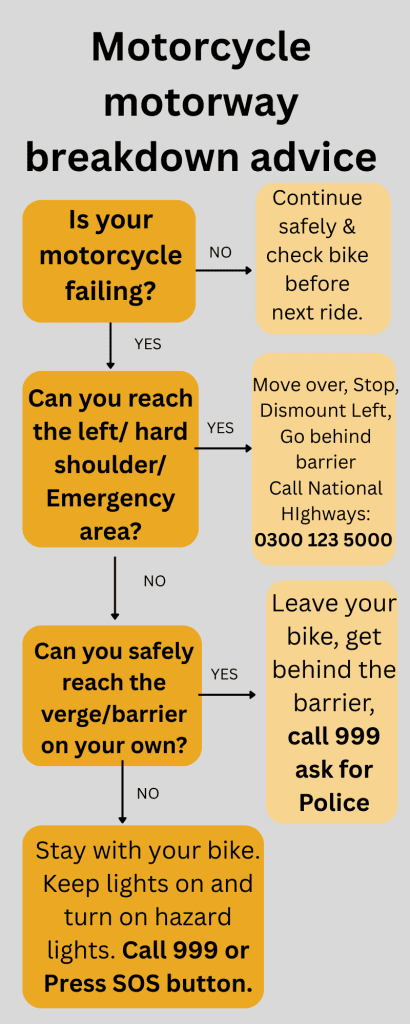
Getting stuck in a live lane may feel disastrous, but it is still not a reason to panic. If you cannot reach a place of relative safety (like an emergency area or the verge behind a barrier), you must dismount and make a quick, critical judgment. National Highways advises that you should only stay with your motorcycle in a live lane if it is absolutely necessary and there’s no safer alternative.
To choose the safest course of action for you and your bike, consider these three Live Lane Factors:
The Golden Rule: If your motorcycle is in a live lane and you’ve managed to get yourself to safety, NEVER RETURN TO IT. Call 999 immediately. The emergency services can close lanes and send a Traffic Officer to manage the situation.
Deciding what to do in a high-pressure, dangerous situation like this is tough. We’ve mapped the logic in a flowchart to help you visualise the Safe System before you ever need to use it.
New motorcycle technology is making the way we handle emergencies safer. Many bikes now come equipped with an SOS button or eCall system. If your bike doesn’t have one, you can get an aftermarket system fitted to your bike. It’s technology worth having as it’ll keep you safe in an emergency.
If you do have this bike tech, you should use it the moment you realize you cannot clear a live lane. These systems usually give GPS coordinates to emergency services, so your location is immediately communicated.
Even without eCall, your hazard lights and parking lights are your primary tools for visibility. Unlike a car, a motorcycle’s battery is small— in a live lane, being seen is more important than saving your battery. Turn them on immediately. If you’re using a smartphone for navigation, the app What3Words can be a literal lifesaver when trying to tell National Highways exactly where you are between junctions. If you don’t already have it on your phone, download it before your next ride.
Safety on the motorway covers what to do in an emergency and the decisions you make every mile before that. We strongly advocate for a Safe System approach to riding and teach it in our advanced training courses. This proactive mindset turns “hoping for the best” into “being prepared for the worst.”
The “Go Left” strategy is significantly easier if you aren’t glued to the outside lane of a four-lane motorway for your entire journey. Stick to the left when you’re not overtaking.
If you do have to dismount and wait behind a barrier, you’re not a rider anymore. You’re a vulnerable pedestrian on the side of a high-speed road.
Motorway riding is often seen as boring, but it’s actually one of the most mentally demanding environments for a motorcyclist. Advanced training for motorways helps you master high-speed observation, emergency positioning and telephone use. That means you’re prepared. If a crisis does occur, your muscle memory and Safe System habits take over.
In the event of an accident, your priority is the safety of everyone involved and the prevention of further collisions. Call 999 and ask for Police and Ambulance services. To prepare for this situation, read our guide Biker Down: Would you know what to do in an accident? to understand the immediate steps you should take to assist, protect the scene, and alert emergency services.
Yes. Unless you are at risk of overheating while waiting, keep all your gear on. It provides a vital layer of protection against debris kicked up by passing HGVs and is your only line of defense in a secondary collision.
Ask for the Police. In a live lane crisis, you need an emergency service that can immediately signal a “Red X” or close lanes to protect you. Once you’re safe, police will coordinate with National Highways for recovery.
No. Motorcycles are exempt from this rule. Attempting to place a triangle 45 meters behind your bike on a motorway is incredibly dangerous. Your visibility comes from your hazard lights, parking lights, and your hi-vis gear—not a plastic triangle.
Tunnels are high-risk environments with very limited space. If your motorcycle is failing, try to clear the tunnel. If you can’t, pull as far to the left as possible and switch on all lights. Use the emergency SOS phones built into the tunnel walls and keep facing traffic while you speak. DO NOT walk back along a live lane to find help.
A motorway breakdown is a test of your nerves, your bike, and your training. Follow the Go Left, Get Safe, Get Help strategy and master the Safe System mindset, to significantly reduce your risk.
Modern technology like eCall and What3Words are brilliant tools, but they’re just that; tools. They need a rider who is calm, prepared, and highly observant to work properly. Safety isn’t just about surviving a motorway breakdown on your motorcycle—it’s about the advanced skills you practice every time you twist the throttle.
Ready to level up your road craft? Explore our Advanced Training Courses to master high-speed observation, motorway positioning, and proactive habits that keep you one step ahead of the unexpected.
With Christmas just around the corner, you might be wondering what to get your favourite motorcycle enthusiast or even a little something for yoursel...
TL;DR: There’s never been a better time to join the UK’s highest-rated motorcycle training network. Be your own boss, escape the 9-5, and turn yo...

Getting a UK motorcycle licence can seem a complicated process. Particularly when compared to a driving licence for a car. Whether you choose the pro...
Phoenix Motorcycle Training is the UK’s highest rated and largest motorcycle training school, so wherever you’re going, we can help you get there.
This website uses cookies to personalise content, ads, and analyse traffic, sharing data with partners who may combine it with other information. See our Privacy Policy for more information.