
7 Top Motorcycle Accessories
With Christmas just around the corner, you might be wondering what to get your favourite motorcycle...
 Phoenix Motorcycle Training LTD
 Phoenix Motorcycle Training LTD
The motorcycle theory test is taken in two parts. Everything kicks off with a motorcycle theory test Q&A about the road rules. Reading the Highway Code and getting familiar with road signs will prepare you well for the multiple choice section. The motorcycle hazard perception test is a little trickier. You’ll need to spot developing hazards in real time, clicking precisely to show you know when danger is calling.
Click a hazard too early because you’re on the ball and you’ll get zero points. Click too late and you’ll be awarded a lowly score instead of collecting the full five points on offer. This is what makes the motorcycle hazard perception test so hard. And it’s exactly why we’re breaking it down for you in this blog.
We’ll clarify which hazards deserve a click, when to click and how to make sure you hit the sweet spot for collecting the most points possible per hazard. Practice makes this easier. Combining these pointers with our 3 tips for learning to ride will give you confidence for booking your CBT course.
At the moment, new riders take a Compulsory Basic Training course (CBT) before their theory or practical tests for a full licence. But there’s a shift on the horizon for the order tests. It’s still early days. The DVSA is only completing the consultation process for their proposed changes to the full licensing journey.
Consultations closed on May 11th. Next comes the review and analysis of responses, research into road safety and licensing data, and gathering stakeholder views on their final proposal. So what are the changes afoot?
Moving the motorcycle hazard perception test and theory exam to the start of the process. So new riders need to pass this before attending Compulsory Basic Training (CBT).
But don’t expect the law to flip overnight. Legislative changes of this scale usually take time to implement. So the current CBT first route is likely to remain for now. Like we advise in our guide to 2026 licensing updates, there is no need to rush your training, but there is a huge benefit to being knowledge-ready.
The shift toward a theory-first model will make your first step into motorcycle licensing safer. When you master hazard perception before swinging a leg over a bike, you:
The most common cause of low scores on the motorcycle hazard perception test is clicking for every single thing you see. If you want full marks, you must distinguish between static and active, developing hazards. This shows you understand the unique threats riders face on the road.
Permanent or stationary features of the road are static hazards. You can think of these as the road environment. They’re things you should notice, but they don’t require you to immediately or drastically change your speed or direction yet.
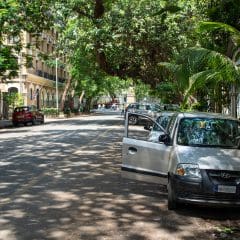
Static hazard examples: A T-junction sign, a pedestrian waiting at a crossing, or a car parked on the side of the road.
When to click: Clicking static hazards gives a zero score—don’t click (yet). You’re being tested on your ability to spot when static hazards evolve into something more.
A static hazard evolves into a developing hazard the moment it prompts you to take action. This is the only thing that earns you points. Consider these scenarios:
Static hazard: A car is waiting at a side road.
Developing hazard: That car’s wheels start to turn, indicator lights begin to flash, or it begins to creep into your lane.
When to click: When you notice movement from the car, the wheels rolling forward or turning or the flash of lights it’s time to click.
Static hazard: Roadwork signs with temporary traffic lights ahead.
Developing hazard: As you approach, the traffic controls change from green to amber, or a worker steps into the road.
When to click: When the light changes or the worker moves, the situation requires you to change speed or road positioning. This is the development you need to click.
You’ll be shown 14 clips throughout the test. Most clips have one developing hazard. At least one clip has two developing hazards. If you click every static hazard you see (like all the parked cars), you run the risk of the software flagging your clicks as random guessing. That triggers the red X and a zero score for that clip.
The motorcycle hazard perception test isn’t just about what you see—it’s about exactly when you see it. That’s why there is a specific scoring window that opens the moment the hazard starts and closes once it’s fully manifested. The closer your click is to the beginning of the hazard development, the higher your score.
The window is divided into five segments. To get the maximum 5 points, you must click in the first segment of that window.
5 Points: You spotted the very first sign of development (e.g.: the wheel twitch or step towards the curb).
4 to 2 Points: You noticed the hazard, but it took you a second or two to react.
1 Point: You clicked just before the hazard was fully completed.
0 Points: You clicked too early (the eager eagle eyes problem) or too late (after the hazard passed).
The DVSA software is incredibly precise, measuring your response to within 1/25th of a second. But a practiced rider (or learner rider) can be even faster. If you click just a fraction of a second before the computer’s “window” officially opens, you get nothing.
This is the scoring trap we mentioned earlier—being too good can lead to zero points. Understanding how the scoring window works lets you work with the program and pass with a high-score.
Because of that 1/25th-of-a-second precision, the most attentive riders can sometimes click too early. If they leave it at that, they’ll miss out on all points for that clip. To make sure your observations are recorded within the software’s 5-point window, a targeted double or triple click secures your points.
Instead of clicking once and hoping for perfect synchronisation with the software’s points-window, try the multi-click method:
This three-click strategy isn’t about clicking randomly. This pattern only works when you’ve identified a specific, developing hazard. Rapid or rhythmic clicking across the whole video triggers the red X and lands you a zero score.
Although precision isn’t paramount, you should avoid using your dashboard clock or guessing. Instead, choose a fixed roadside marker. A sign, lamp post, or bridge will do the trick. Start your count (“One-one-thousand, two-one-thousand…”) the moment the vehicle in front passes that marker. If your front tyre reaches that point before you finish saying “four,” you need to ease off and reset your gap by beginning the count again.
It’s not just motorcycles, cars need to extend their following distance in the wet too. It is more important for motorcycles for a few reasons…
Extra space is a rider’s only real safety net.
Absolutely. The Highway Code specifically instructs riders to at least double the standard 2-second gap in adverse weather. Mastering this isn’t just for the theory test; it’s a core skill examiners look for during your CBT and Module 2 road tests too.
It feels counter-intuitive, but you should increase the gap in front of you. By creating a 5 or 6-second buffer ahead, you make room for braking gently. This protects you from being rear-ended by the tailgater and gives them more time to react to your movements too.
The best way to pass is through practice and repetition. We recommend using official practice materials and supplementing these with practice tests from Esitu Solutions. This will give you a good feel for the scoring windows before your actual test date.
The mechanics and the video clips used in the official DVSA test are actually the same for both cars and motorcycles. However, as a rider, you’re expected to show a higher level of awareness so the marking is different. The pass mark for the motorcycle HPT is 44 out of 75, whereas for cars it is 43 out of 75.
We recommend practicing with motorcycle-specific clips because they prepare you for real-world hazards that the official test can miss. Things like road surface changes, filtering risks, and the specific vantage point you’ll have from the saddle. These will prepare you well for the tests and real-world situations.
In short: No. The DVSA’s software can detect gaming. Random pattern clicking is likely to land you with a zero score because the system flags the clip with a red X. This means you get nothing, even if you actually spotted the hazard. Stick to the targeted clicks for specific hazards only.
Yes. We work with and recommend ESitu Solutions. Their scientific approach to developing their practice HPT clips is leading the industry. Their clips feature real-world rider scenarios and situations, provide instant feedback to help you achieve the highest score and develop the skills to gain confidence before your official theory test.
Yes, you can and should practice for the motorcycle hazard perception test. Esitu Solutions offer realistic video simulations designed specifically to sharpen your anticipation skills and improve your timing for the sliding score window of the DVSA motorcycle theory test.
The Hazard Perception Test (HPT) is the second part of the UK motorcycle theory test. It uses video clips to test your ability to spot ‘developing hazards’. Situations that could cause you to change speed or direction and react to them in time. The faster you spot each hazard, the higher points you’ll be awarded.
Practicing for the motorcycle hazard perception test sets you up for life-long success as a rider AND helps you ace the DVLA test.
Mastering the motorcycle hazard perception test is one of the most important steps in your journey to becoming a rider. By understanding the 5-point window, you can turn a tricky test into a confident pass.
Whether the proposed 2026 licensing changes are implemented or the current route remains, being prepared is the best way to ensure your training is smooth, safe, and enjoyable. Ready to get on two wheels? Find a CBT course near you and make use of our pre-training resources you’ll get access to once you’ve booked.
With Christmas just around the corner, you might be wondering what to get your favourite motorcycle...

TL;DR: There’s never been a better time to join the UK’s highest-rated motorcycle training netw...

Getting a UK motorcycle licence can seem a complicated process. Particularly when compared to a dri...
Phoenix Motorcycle Training is the UK’s highest rated and largest motorcycle training school, so wherever you’re going, we can help you get there.
This website uses cookies to personalise content, ads, and analyse traffic, sharing data with partners who may combine it with other information. See our Privacy Policy for more information.